Monday, December 10, 2012
New reviews: Nintendo Land, Hotline Miami
I just put two new reviews up over on GamerCheese.com - Nintendo Land and Hotline Miami. I know what you are thinking - "Sol, these are very similar games! However did you manage to keep them straight in your head?" Suddenly the idea of Mario Chase involving all of the Toads wielding lead pipes popped into my head, and I'm a little bit sad. Anyway, check out the reviews - both games are excellent and worth a look.

Sunday, December 2, 2012
Humble Bundle announces Humble THQ Bundle!
I wrote a bit about this at GamerCheese.com - you can find the full piece here.
Tuesday, November 27, 2012
Gaming, and Cheese
Hi, all,
I am going to be writing posts for GamerCheese starting yesterday! My first post, on whether to get a Wii U, is already up. I'll be trying to post for GamerCheese more frequently - every weekday, if I can manage it, and Monday-Wednesday-Friday if not. That probably means fewer original posts for this blog, though; I'm going to have to balance my time between doing even more writing and other things, like work and the game. I'll always post links to new articles here and on my Twitter, though.
Thanks as always for following along, and I hope you'll keep up with me at the new site!
I am going to be writing posts for GamerCheese starting yesterday! My first post, on whether to get a Wii U, is already up. I'll be trying to post for GamerCheese more frequently - every weekday, if I can manage it, and Monday-Wednesday-Friday if not. That probably means fewer original posts for this blog, though; I'm going to have to balance my time between doing even more writing and other things, like work and the game. I'll always post links to new articles here and on my Twitter, though.
Thanks as always for following along, and I hope you'll keep up with me at the new site!
Wednesday, November 21, 2012
Wii U: Impressions
On Sunday, my girlfriend and I made a decision about how long we would be willing to wait outside our local Target for a Wii U, and ended up in line about five minutes before the tickets were handed out, and we ended up a ticket good for the second-to-last deluxe model. I won't call our timing anything other than fabulous luck, but it does mean that I get to come to you all the day after release with my first impressions of the device and a couple of its games.
First: There is a system update at the beginning that takes in the neighborhood of an hour. This is a very frustrating thing to deal with out-of-the-box, and I've heard reports that if you shut the system off during that update, you can brick it. So, don't do that.
Once our update finished we played a bit of Nintendo Land, by which I mean several hours' worth. This game itself is reason enough to spring for the deluxe model, and does a fabulous job of displaying some of the new capabilities and possibilities the console offers. In case you haven't heard of it, it's a virtual theme park-styled game that offers "attractions" (mini-games) based on various Nintendo properties from Game-And-Watch to Metroid to F-Zero to Animal Crossing. Some are single-player, but many offer some form of multiplayer that makes some use of the WiiU GamePad and the traditional Wii remotes. There are a few things we noticed about how the experience played out:
-The graphics are gorgeous. The game itself doesn't push too many boundaries technologically, but the technology amply supports the game's art style, which is beautiful. Each attraction has its own theme, but they share common style elements; in most, the scenery looks constructed, so even though the robotic goblins in the Zelda-themed attraction and the quiltwork backgrounds in the Balloon Trip Breeze attraction look substantially different they feel thematically similar. In all the attractions, too, you'll be controlling Miis dressed up like characters from the games. In one you might be dressed as Mario, or as a Pikmin. Every attraction feels like it captures a little bit of the essence of the game it's based on while still blending into the theme park aesthetic. It's a great feel.
-The GamePad feels good. The screen looks great, and is responsive to touch. It's very lightweight, and holding it with both hands I found it rarely got too heavy (in some attractions where you hold it with one hand, it can start to be a little heavy). I never had any technical difficulty with the screen being unresponsive. More importantly, the GamePad is getting used in interesting ways; it's fun throwing stars with it in the ninja attraction, it's fun using it to evade your captors in the hide-and-seek-like Mario attraction, and it's fun using it as a kind of 360-degree viewfinder in the Zelda attraction, where you'll be firing at enemies on all sides. It makes me very, very optimistic about what might be possible with this in the future.
-It's really fun to watch. In general, I do like watching people play video games, but only occasionally can I convince my girlfriend to watch me play. With Nintendo Land, we both had a lot of fun both playing and watching. For a number of the events, the camera on the game pad is used to highlight whoever's playing, and it's a lot of fun to see the silly faces people make as they play. It doesn't hurt at all that the game itself is fun to look at, either. The idea of games as a spectator sport has been explored before, but in this case it's just fun to watch your friends and family play. It definitely reminds me of some of what was cool about Wii Sports when it first came out.
We've still got a lot of playing around with the Wii U itself to do - we haven't yet explored much of the online functionality, including the Miiverse - but in general it's hard not to love it. We've been mostly playing Nintendo Land and New Super Mario Bros. U, and they do feel very casual. Both have drop-in, drop-out multiplayer that's incredibly easy to do, and switching roles can keep things exciting, too. As busy as we often feel, it's really nice to feel like we can get ten or fifteen minutes of gameplay in and really still experience a meaningful chunk of the game; when you're used to playing games like Starcraft 2 or Skyrim, which unfold a lot more slowly, it's nice to have a slightly more casual option.
I should also mention that we picked up Assassin's Creed 3, in part at least because we live in Boston and we've always wanted to climb on Faneuil Hall and jump on people and all that. (You know, just startle the people coming out of the Urban Outfitters and then blend in with the performance artists and stuff and maybe have some clam chowder. I'm pretty sure that's in the game.) I haven't played AC3 on any other platform so I'm not really in a good place to make comparisons, but I can say that it looks stunning - leaps and bounds above what the Wii could do, obviously. Shimmering polygons flying around the loading screens reflecting everything are more than I think my brain knows how to handle. And it looks every bit as beautiful on the GamePad screen, too. Nothing about how the game uses the GamePad makes me think the experience is any better on the Wii U than it would be on another console. But for someone like me, who doesn't have another HD gaming console, it's a really nice claim for the Wii U to be able to make - though especially since HD consoles are so common, it's more of a prerequisite than a selling point. It seems as though it'll be able to hold its own in the high-end, AAA gaming market for a few years at least, though, which is an important step up over its predecessor.
If you're not sold on the Wii U, I might say wait until you see something that really catches your eye before you buy one. But I'd also say to try out some of the games that might not have immediately impressed you. I didn't really think Nintendo Land or New Super Mario Bros. U would hook me as much as they did, but the uses of the GamePad and the technology are really clever and fun, and hold a lot of promise. For me, the eventual purchase was inevitable; there will almost certainly be a Zelda or a Metroid for this console, and I will have them. If there's a similar inevitability for you right now, then you probably won't regret picking one up as soon as you can; there will be plenty to hold your interest. If not, then try one out and see how it feels to you; you might find there's something more than you expected there.
 |
| The Deluxe one is also prettier. |
First: There is a system update at the beginning that takes in the neighborhood of an hour. This is a very frustrating thing to deal with out-of-the-box, and I've heard reports that if you shut the system off during that update, you can brick it. So, don't do that.
.JPG) |
| This was the least fun part. |
Once our update finished we played a bit of Nintendo Land, by which I mean several hours' worth. This game itself is reason enough to spring for the deluxe model, and does a fabulous job of displaying some of the new capabilities and possibilities the console offers. In case you haven't heard of it, it's a virtual theme park-styled game that offers "attractions" (mini-games) based on various Nintendo properties from Game-And-Watch to Metroid to F-Zero to Animal Crossing. Some are single-player, but many offer some form of multiplayer that makes some use of the WiiU GamePad and the traditional Wii remotes. There are a few things we noticed about how the experience played out:
-The graphics are gorgeous. The game itself doesn't push too many boundaries technologically, but the technology amply supports the game's art style, which is beautiful. Each attraction has its own theme, but they share common style elements; in most, the scenery looks constructed, so even though the robotic goblins in the Zelda-themed attraction and the quiltwork backgrounds in the Balloon Trip Breeze attraction look substantially different they feel thematically similar. In all the attractions, too, you'll be controlling Miis dressed up like characters from the games. In one you might be dressed as Mario, or as a Pikmin. Every attraction feels like it captures a little bit of the essence of the game it's based on while still blending into the theme park aesthetic. It's a great feel.
 |
| It's just so fun to look at! |
-It's really fun to watch. In general, I do like watching people play video games, but only occasionally can I convince my girlfriend to watch me play. With Nintendo Land, we both had a lot of fun both playing and watching. For a number of the events, the camera on the game pad is used to highlight whoever's playing, and it's a lot of fun to see the silly faces people make as they play. It doesn't hurt at all that the game itself is fun to look at, either. The idea of games as a spectator sport has been explored before, but in this case it's just fun to watch your friends and family play. It definitely reminds me of some of what was cool about Wii Sports when it first came out.
We've still got a lot of playing around with the Wii U itself to do - we haven't yet explored much of the online functionality, including the Miiverse - but in general it's hard not to love it. We've been mostly playing Nintendo Land and New Super Mario Bros. U, and they do feel very casual. Both have drop-in, drop-out multiplayer that's incredibly easy to do, and switching roles can keep things exciting, too. As busy as we often feel, it's really nice to feel like we can get ten or fifteen minutes of gameplay in and really still experience a meaningful chunk of the game; when you're used to playing games like Starcraft 2 or Skyrim, which unfold a lot more slowly, it's nice to have a slightly more casual option.
I should also mention that we picked up Assassin's Creed 3, in part at least because we live in Boston and we've always wanted to climb on Faneuil Hall and jump on people and all that. (You know, just startle the people coming out of the Urban Outfitters and then blend in with the performance artists and stuff and maybe have some clam chowder. I'm pretty sure that's in the game.) I haven't played AC3 on any other platform so I'm not really in a good place to make comparisons, but I can say that it looks stunning - leaps and bounds above what the Wii could do, obviously. Shimmering polygons flying around the loading screens reflecting everything are more than I think my brain knows how to handle. And it looks every bit as beautiful on the GamePad screen, too. Nothing about how the game uses the GamePad makes me think the experience is any better on the Wii U than it would be on another console. But for someone like me, who doesn't have another HD gaming console, it's a really nice claim for the Wii U to be able to make - though especially since HD consoles are so common, it's more of a prerequisite than a selling point. It seems as though it'll be able to hold its own in the high-end, AAA gaming market for a few years at least, though, which is an important step up over its predecessor.
If you're not sold on the Wii U, I might say wait until you see something that really catches your eye before you buy one. But I'd also say to try out some of the games that might not have immediately impressed you. I didn't really think Nintendo Land or New Super Mario Bros. U would hook me as much as they did, but the uses of the GamePad and the technology are really clever and fun, and hold a lot of promise. For me, the eventual purchase was inevitable; there will almost certainly be a Zelda or a Metroid for this console, and I will have them. If there's a similar inevitability for you right now, then you probably won't regret picking one up as soon as you can; there will be plenty to hold your interest. If not, then try one out and see how it feels to you; you might find there's something more than you expected there.
Saturday, November 17, 2012
Heritage of a Gamer
If you aren't familiar with Extra Credits, I can't recommend it highly enough; it's hosted on the Penny Arcade site and has weekly animated shorts discussing some aspect of games from a very academic, intelligent perspective. They have more and better critiques of games, from an artistic or a social perspective, than anything similar I've seen. Their most recent episode addressed the difficulty of maintaining access to games after the technologies they run on have gone away. This I thought tied in nicely with my post from earlier in the week about how technology guides our games.
The show addressed the question of what we stand to gain if we have access to older games, and what we lose in contrast to other media when an old game is lost. A question invited by that one, though, is: What does the heritage of gaming look like now?
If you're anything like me, when you think about how games used to be you probably think about what games were like when you first started playing. I remember the Super Nintendo of my youth, the N64, and so on. If I encountered games that were older than those, it was usually because I was seeking out an earlier entry in a franchise I loved - hunting down Metroid after I beat Super Metroid, trying to crawl through the original Zelda, and so on. I don't think this experience is unique to me; I think people sometimes inherit systems and games from friends and family, but I'd expect that, except in rare cases, that will be from people their age or a little older, so likely they're not reaching that far back. If it's the case that most gamers haven't really inherited much themselves - they've only picked up the new, observed what's happened in their lifetime or just before - then the task of themselves becoming caretakers of the medium seems more challenging. When you yourself have been the recipient of a particular kind of cultural knowledge, you know better how to pass it down; without that experience, it's harder.
One of the biggest considerations, though, is that there isn't really a strong structure for passing down video games yet. You can find a college offering a degree in Engilsh literature almost anywhere; art or art history degrees, and cinema/filmography/film history degrees aren't much harder to find. It's certainly not impossible to find courses in video game development, but video game history? Almost impossible. Imagine taking a class on first-person shooters, on shifting views of race and social structures in the GTA series, on femininity in games. The idea of this would be insane to many (most?) people who don't play games, and probably a high percentage of those who do. And that right there is a serious consideration. If games aren't treated as art, as being vessels of important cultural information worthy of study, they will not be preserved. The same goes for the craft as well as the art: if we don't appreciate design choices in older games that used more limited technology, we're going to miss some important lessons. You may scoff at Super Metroid's outdated graphics, but you can learn a lot by watching how the controls work, or how the camera follows you, that you'd otherwise have to figure out on your own. Seeing good - and bad - choices made by earlier games, seeing how those games evolved as new technologies appeared, can help us make choices that will help our games survive longer. The more we as gamers think about games in this way, the more likely others will find that kind of value in them. When there's a need perceived to preserve these games, the ability to do so will follow.
If you're not the kind of person who has much patience for literature as an academic pursuit, this argument may not hold water for you. I've met a number of people who think that dedicating any amount of time or energy to the study of films or novels or video games is a waste of time because these aren't necessarily practical skills. And from a vocational perspective, that might be reasonable. But we have to remember that as historical objects, works of fiction can contain pretty densely packed information about the society they exist in. These objects are worthy of study because of what they tell us about ourselves; if we don't want to let that information ever last more than a few hardware life cycles, the medium is going to lose a lot of continuity, and our games will suffer for it.
Besides - I don't want to wake up one day, any day, and realize I won't ever be able to play the original Katamari Damacy again. I'm sure I'm not the only one who feels this way.
The show addressed the question of what we stand to gain if we have access to older games, and what we lose in contrast to other media when an old game is lost. A question invited by that one, though, is: What does the heritage of gaming look like now?
If you're anything like me, when you think about how games used to be you probably think about what games were like when you first started playing. I remember the Super Nintendo of my youth, the N64, and so on. If I encountered games that were older than those, it was usually because I was seeking out an earlier entry in a franchise I loved - hunting down Metroid after I beat Super Metroid, trying to crawl through the original Zelda, and so on. I don't think this experience is unique to me; I think people sometimes inherit systems and games from friends and family, but I'd expect that, except in rare cases, that will be from people their age or a little older, so likely they're not reaching that far back. If it's the case that most gamers haven't really inherited much themselves - they've only picked up the new, observed what's happened in their lifetime or just before - then the task of themselves becoming caretakers of the medium seems more challenging. When you yourself have been the recipient of a particular kind of cultural knowledge, you know better how to pass it down; without that experience, it's harder.
One of the biggest considerations, though, is that there isn't really a strong structure for passing down video games yet. You can find a college offering a degree in Engilsh literature almost anywhere; art or art history degrees, and cinema/filmography/film history degrees aren't much harder to find. It's certainly not impossible to find courses in video game development, but video game history? Almost impossible. Imagine taking a class on first-person shooters, on shifting views of race and social structures in the GTA series, on femininity in games. The idea of this would be insane to many (most?) people who don't play games, and probably a high percentage of those who do. And that right there is a serious consideration. If games aren't treated as art, as being vessels of important cultural information worthy of study, they will not be preserved. The same goes for the craft as well as the art: if we don't appreciate design choices in older games that used more limited technology, we're going to miss some important lessons. You may scoff at Super Metroid's outdated graphics, but you can learn a lot by watching how the controls work, or how the camera follows you, that you'd otherwise have to figure out on your own. Seeing good - and bad - choices made by earlier games, seeing how those games evolved as new technologies appeared, can help us make choices that will help our games survive longer. The more we as gamers think about games in this way, the more likely others will find that kind of value in them. When there's a need perceived to preserve these games, the ability to do so will follow.
If you're not the kind of person who has much patience for literature as an academic pursuit, this argument may not hold water for you. I've met a number of people who think that dedicating any amount of time or energy to the study of films or novels or video games is a waste of time because these aren't necessarily practical skills. And from a vocational perspective, that might be reasonable. But we have to remember that as historical objects, works of fiction can contain pretty densely packed information about the society they exist in. These objects are worthy of study because of what they tell us about ourselves; if we don't want to let that information ever last more than a few hardware life cycles, the medium is going to lose a lot of continuity, and our games will suffer for it.
Besides - I don't want to wake up one day, any day, and realize I won't ever be able to play the original Katamari Damacy again. I'm sure I'm not the only one who feels this way.
Tuesday, November 13, 2012
Elements of Design: Technology
The last few times I've sat down to work on the game, I've been wrangling the same problem. I set my protagonists next to one another . . .
. . . push a couple buttons . . .
. . . and watch as the girl drifts off the top of the level, never to be seen again.
Now, this is not ENTIRELY inconsistent with the behavior I'm going for, but it's still something of a problem. If you are the sort of person who has messed with code in a game context or otherwise, you probably know about putting on your Code Gloves (like gardening gloves but smellier) and getting mussy up to your elbow in brackets and semicolons. It's fun and rewarding when you find an elegant solution to a problem, but as one concern starts to dominate your time you can begin to panic at the amount of resources you're pouring into solving a problem you never considered might exist.
One of the major differences between my esteemed co-developer and myself is that if I could magic the game and physics and behavior into existence with a nod of my head, without any of the mucking about in Javascript, I would do so. My partner wouldn't have it so; to him, the code itself is something beautiful and a lovely process, and on days when it's going right I can be impressed by our accomplishments too - but on other days, I wish I were making a board game. Whichever pole you gravitate towards - and if you're a dev, you probably bounce between them - your game is going to be supported by some kind of technology, so I want to examine some of the considerations of technology. Since I'm mainly interested in video games, I'll be talking mostly about code, but remember that your "technology" could just as easily be a board, or some cards, or a stack of books and some dice.
One of the things that's really cool about code is that it is one of the most tactile, controllable aspects of a game's design. In a medium that's really fuzzy and lacks a lot of precision or definition, this is an advantage we should cling to for dear life. Like the art, or the balance, or the story, code can be tweaked, code can bloat, code can be missing crucial elements or weighed down with unnecessary elements. The advantage is that code is more strict than the other parts of the game. If you're doing something critically wrong with your script, it won't compile, and you will know immediately; if you're doing something critically wrong with your art, it'll suck, and you probably won't know why or how to fix it for awhile. When you are rightfully kicking yourself in the head for the typo during the villain's grand speech just before the final confrontation, you will wish that the person typing your story up could be as strict as your compiler. Your code can still suffer from vagueness or lack of clarity, and can still have corner-cases you can't always see, but its representation is at least concrete and responsive.
Technology, of course, offers a lot of limitations. You can't do better than the system you're working on or the tools you're using for implementation. For our own game, we're more limited right now by what we don't know how to do than what our computers or Unity can pull off, but think about the kinds of experiences that weren't possible until recently. Would Minecraft have been doable before it was possible to generate worlds of that magnitude? Could we have the experience of World of Warcraft before the infrastructure existed to support so many characters in the same world? Still, I'm going to assume the majority of my audience is limited not by the available technology, but by their ability to use it - in terms of time, resources, skill, etc. If I were a master of Unity and Illustrator and Blender my game would be a lot prettier, but since I'm not, we make do; maybe our game could be using more of the available technology, or using it more efficiently, but we have to work with the skills we have.
Sometimes, though, that isn't a bad thing. Part of what appealed to us about a shadow puppet-style game is that it was within our abilities. Our characters can look pretty static, and have simple animations, and still adhere to the aesthetic. It can even be charming. Similarly, though I'm certain there was no lack of skill that limited Mike Bithell to rectangular characters and platforms in Thomas Was Alone, the simplest uses of Unity suggest those kinds of shapes; starting with very basic uses of technology and using that as a stylistic theme helps direct the art of the game. Benjamin Rivers of Home imposed similar limitations on himself, to the betterment of the game. Pushing technology to its limits can produce something really wonderful if your vision is well-planned out, provided that vision isn't visibly handicapped by its execution. But when a game is visibly aware of its technology, and plays on the limitations of that technology in an elegant way, it can serve to unify the experience, as Thomas Was Alone demonstrated so successfully. If your technology doesn't get in your way, that's good; but careful understanding of it is what makes it not just an enabler of your game, but an active agent working towards whatever single purpose unites the disparate elements of your game.
Thinking about technology in this way gives us some interesting lenses for examining games. Is this game making full use of its technology? Is it handicapped by its technology? Is it playing off the strengths and limitations of that technology to achieve its purpose? Looking at technology is a way of examining our tools, and deciding whether those tools are sufficient for our vision, and whether we are using them in a way that makes our game as beautiful as it can be.
 |
| It was very gracious of them to pose for this shot. |
. . . push a couple buttons . . .
 |
| up up down down left right left right b a start |
 |
| The sense of abandonment is sobering but not exactly what was intended |
One of the major differences between my esteemed co-developer and myself is that if I could magic the game and physics and behavior into existence with a nod of my head, without any of the mucking about in Javascript, I would do so. My partner wouldn't have it so; to him, the code itself is something beautiful and a lovely process, and on days when it's going right I can be impressed by our accomplishments too - but on other days, I wish I were making a board game. Whichever pole you gravitate towards - and if you're a dev, you probably bounce between them - your game is going to be supported by some kind of technology, so I want to examine some of the considerations of technology. Since I'm mainly interested in video games, I'll be talking mostly about code, but remember that your "technology" could just as easily be a board, or some cards, or a stack of books and some dice.
One of the things that's really cool about code is that it is one of the most tactile, controllable aspects of a game's design. In a medium that's really fuzzy and lacks a lot of precision or definition, this is an advantage we should cling to for dear life. Like the art, or the balance, or the story, code can be tweaked, code can bloat, code can be missing crucial elements or weighed down with unnecessary elements. The advantage is that code is more strict than the other parts of the game. If you're doing something critically wrong with your script, it won't compile, and you will know immediately; if you're doing something critically wrong with your art, it'll suck, and you probably won't know why or how to fix it for awhile. When you are rightfully kicking yourself in the head for the typo during the villain's grand speech just before the final confrontation, you will wish that the person typing your story up could be as strict as your compiler. Your code can still suffer from vagueness or lack of clarity, and can still have corner-cases you can't always see, but its representation is at least concrete and responsive.
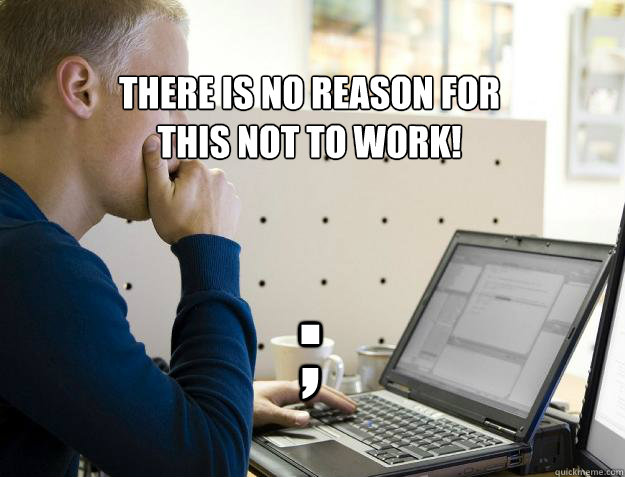 |
| Semicolons are the lucky ones. It's null pointers you must beware. |
Technology, of course, offers a lot of limitations. You can't do better than the system you're working on or the tools you're using for implementation. For our own game, we're more limited right now by what we don't know how to do than what our computers or Unity can pull off, but think about the kinds of experiences that weren't possible until recently. Would Minecraft have been doable before it was possible to generate worlds of that magnitude? Could we have the experience of World of Warcraft before the infrastructure existed to support so many characters in the same world? Still, I'm going to assume the majority of my audience is limited not by the available technology, but by their ability to use it - in terms of time, resources, skill, etc. If I were a master of Unity and Illustrator and Blender my game would be a lot prettier, but since I'm not, we make do; maybe our game could be using more of the available technology, or using it more efficiently, but we have to work with the skills we have.
Sometimes, though, that isn't a bad thing. Part of what appealed to us about a shadow puppet-style game is that it was within our abilities. Our characters can look pretty static, and have simple animations, and still adhere to the aesthetic. It can even be charming. Similarly, though I'm certain there was no lack of skill that limited Mike Bithell to rectangular characters and platforms in Thomas Was Alone, the simplest uses of Unity suggest those kinds of shapes; starting with very basic uses of technology and using that as a stylistic theme helps direct the art of the game. Benjamin Rivers of Home imposed similar limitations on himself, to the betterment of the game. Pushing technology to its limits can produce something really wonderful if your vision is well-planned out, provided that vision isn't visibly handicapped by its execution. But when a game is visibly aware of its technology, and plays on the limitations of that technology in an elegant way, it can serve to unify the experience, as Thomas Was Alone demonstrated so successfully. If your technology doesn't get in your way, that's good; but careful understanding of it is what makes it not just an enabler of your game, but an active agent working towards whatever single purpose unites the disparate elements of your game.
Thinking about technology in this way gives us some interesting lenses for examining games. Is this game making full use of its technology? Is it handicapped by its technology? Is it playing off the strengths and limitations of that technology to achieve its purpose? Looking at technology is a way of examining our tools, and deciding whether those tools are sufficient for our vision, and whether we are using them in a way that makes our game as beautiful as it can be.
Friday, November 9, 2012
Review - Thomas Was Alone
When I first started playing around with Unity while beginning work on Candlelight, I made the simplest level I could. It had rectangles for characters, rectangles for walls, very simple physics, and a very simple aesthetic. A few people said "You know, this could almost work as a game." And the people who made Thomas Was Alone proved them right.
Thomas Was Alone is a Unity-based platformer by Mike Bithell that follows the adventures of fledgling AIs as they slowly gain awareness of themselves, their environment, and one another. You begin play as Thomas, an orange, rectangular AI, and gradually add more AI friends with different abilities to your fold, with the goal of each level to get all of your rectangles to their respective end portal. You can switch between the characters as you please, and their abilities range from simple (John's great jump distance) to more specific (Claire's ability to survive the game's toxic water) to outright detrimental (Chris's slow speed and low jump). The levels are about using the character's abilities to compensate for one another's shortcomings.
Every element of the game has a refined simplicity: the characters are just little rectangles, but they wobble and bend when they jump; the backgrounds are unobtrusive, but pulse with little symbols and pixels like the inside of a computer program; there is no dialogue, but the story is expertly narrated and brings just the right amount of emotion and humor. The game enjoys a straightforward, no-(some)-nonsense style, but it doesn't use that as an excuse to slouch when bringing life and activity to the details.
The characters are the stars of the game, and their story is delightful and adorable. Despite having no voices, faces, or curves, the characters are some of the best I've seen this year; the narrator explores each of their internal monologues and insecurities and aspirations, all of which extend naturally into those characters' abilities. The humor is sometimes deprecating, but not as spiteful or unrelenting as that of, say, Portal; Chris is meaner than he needs to be to Thomas, but is lonely when they are separated. Portal's humor works because GLaDOS is a sociopath, where Thomas Was Alone's humor works because the characters are all believable and likable. The story has a couple neat turns but isn't overly complicated, and like the rest of the rest of the game it succeeds not by doing anything enormously groundbreaking but by weaving its charm and style into every aspect of the experience.
Thomas Was Alone isn't an especially long game, and the difficulty never ramps up out of control. Though the story and its ending feel complete, it's a little sad to put those characters away when you get through the last level. But at its end, the game is like a little peek into a beautiful world, and too much more might spoil the illusion. Bithell's creation is an excellent platforming experience, and remarkably fun, but in addition, it's a case study in common purpose uniting a design: every aspect of the story, the visuals, the sound, the level design, and most importantly the characters is in alignment, and all feel deliberate, targeted, and successful. This is what makes Thomas Was Alone a good game; that all of those elements, and the game they serve, happen to be so vital and enjoyable is what makes it a great game.
Website: http://www.thomaswasalone.com/
Mike Bithell's Twitter: https://twitter.com/mikeBithell
 |
| I've felt this way about the world sometimes. |
 |
| You, too, will come to find stairs difficult. Consider yourself warned. |
Every element of the game has a refined simplicity: the characters are just little rectangles, but they wobble and bend when they jump; the backgrounds are unobtrusive, but pulse with little symbols and pixels like the inside of a computer program; there is no dialogue, but the story is expertly narrated and brings just the right amount of emotion and humor. The game enjoys a straightforward, no-(some)-nonsense style, but it doesn't use that as an excuse to slouch when bringing life and activity to the details.
 |
| They're a festive bunch, and assembling the team feels kind of cool. Like The Avengers only the characters are, somehow, less two-dimensional. |
 |
| It might feel hard to write a lot of emotional significance into rectangles, but you will. |
Website: http://www.thomaswasalone.com/
Mike Bithell's Twitter: https://twitter.com/mikeBithell
Subscribe to:
Posts (Atom)